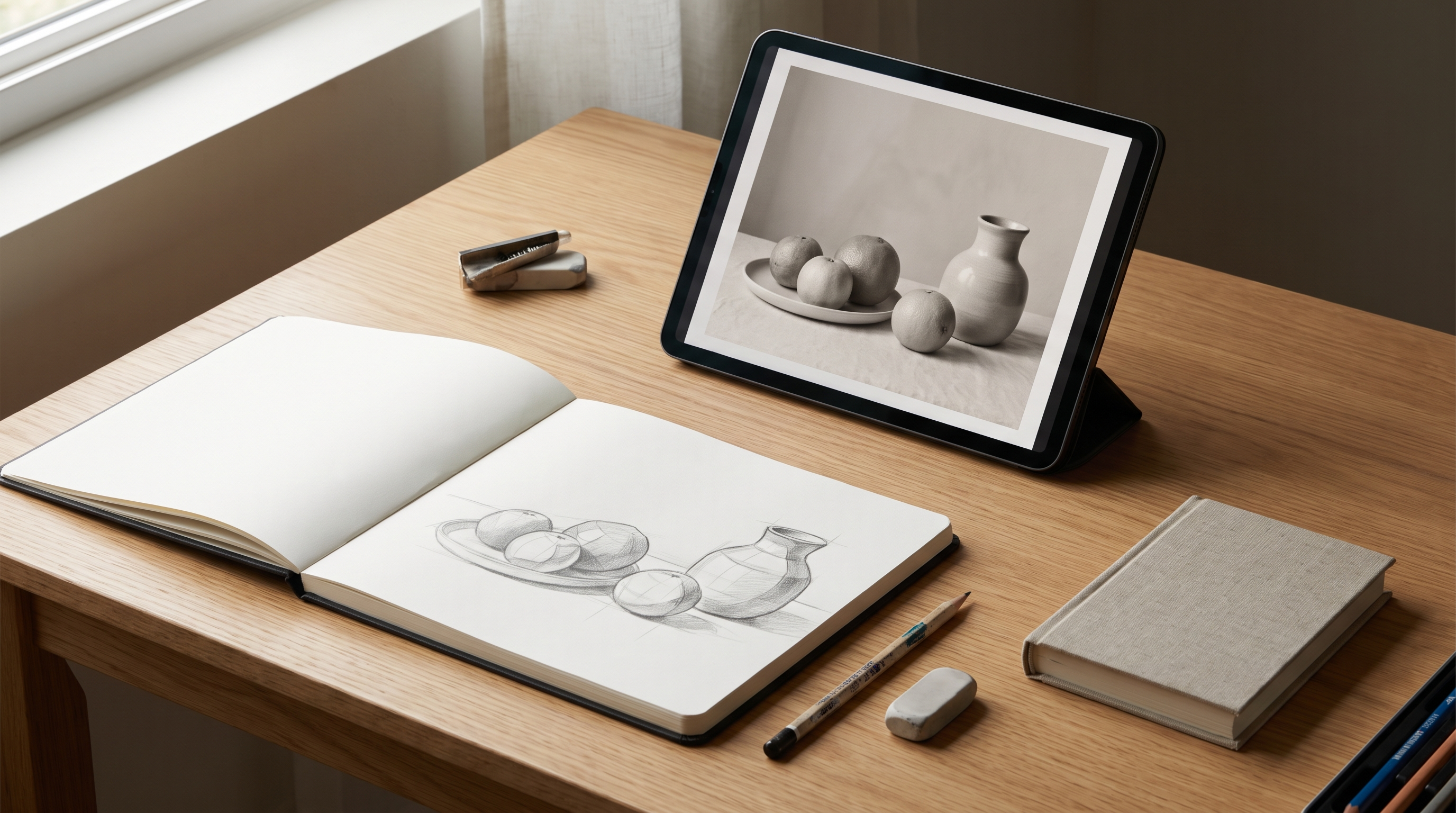

How to Choose a Good Reference Photo for Drawing

Choosing a strong reference photo for drawing

Choosing a reference is part of learning to draw. A beautiful photo is not automatically a useful drawing reference, especially for beginners. A strong reference makes shape, proportion, light, and value easier to understand rather than forcing you to guess.

Look for clear lighting

Side lighting or angled light often reveals form better than flat frontal lighting. Look for an obvious separation between light and shadow so you can understand the volume of the subject quickly.

Avoid blurry or heavily compressed images

Low-resolution images hide important edges and small structural changes. Choose a reference that remains readable when you zoom into the areas that matter.

Choose a manageable angle

For beginners, moderate viewpoints are usually easier than extreme foreshortening or wide-angle distortion. Once your construction skills improve, difficult viewpoints become useful challenges rather than sources of confusion.

Be careful with strong filters

Filters can shift skin color, crush shadows, brighten highlights, and change contrast in unnatural ways. If your goal is realistic study, choose references with believable light and color.

Check the value structure

Squint at the reference or temporarily view it in grayscale. If the subject still reads clearly as large light, middle, and dark shapes, it will usually translate well into a drawing.

Understand usage rights

For private practice, artists often study from a wide range of references. For commercial work, publication, redistribution, or closely derived work, make sure you have the right to use the source. Licensed images or your own photography give you the clearest control.

Create your own references

Photographing your own subject gives you full control over composition and lighting. For still life, arrange objects under one light and photograph several angles. For portraits, experiment with head direction and light placement before choosing the final image.

A useful comparison exercise

Choose two references of the same kind of subject: one with flat light and one with side light. Make a quick value study of each and compare which one explains the form more clearly.

A good reference does not do the drawing for you. It simply gives you better information to work from.

Reference challenge

Share two possible references in the Community Feed and explain which one you would choose and why.

Related Articles

Responses

Your email address will not be published. Required fields are marked *